If you’re shopping for a leather living room sofa, you’ve probably stared at a few options in store or online, wondering how deep they actually are. I’ve been in the sofa supply game for over a decade now, and one question we get all the time from customers is: “What’s the average depth of a good leather living room sofa?” It’s such a big deal—too shallow and you’ll feel like you’re perched on a kid’s chair instead of curling up with a show; too deep and your feet won’t reach the floor, leaving you uncomfortable after 10 minutes. Let’s break this down like we’re chatting over coffee, no stuffy textbook jargon. Leather Living Room Sofa

First, let’s get clear on what “sofa depth” actually means, because it’s not the same as length or height. The depth is the measurement from the front edge of the seat cushion (where you sit) back to the wall or the back of the sofa. Some people mix it up with seat depth, which is a little different—seat depth is the space from the front of the cushion to the backrest, so it’s a touch smaller than the overall sofa depth. For example, if the overall depth is 85cm, the seat depth is usually around 60-65cm, which is what most people really care about for comfort.
Now, what’s the average? From what we’ve tracked with thousands of sofas we’ve supplied to homes, apartments, and even offices over the years, the average depth for a standard leather living room sofa is between 80cm and 95cm. That’s roughly 31.5 to 37 inches, for my US-based folks. But wait—this isn’t a one-size-fits-all number. It shifts based on the type of sofa, who’s using it, and even how big their living room is.
Let’s talk about different sofa types because that changes the average. A compact loveseat (the two-seater smaller than a full sofa) is usually shallower, around 75-80cm (29.5 to 31.5 inches). We make a lot of these for city apartments where space is tight—they’re great for couples or small families, and the average depth here is on the lower end, since you don’t need as much room. Then there’s the standard three-seater, which is the most popular for most households. Its average depth? 85-90cm (33.5 to 35.5 inches). That’s the sweet spot for most people—you can slouch, sit up straight, and still have room for a throw pillow or a side table next to it.
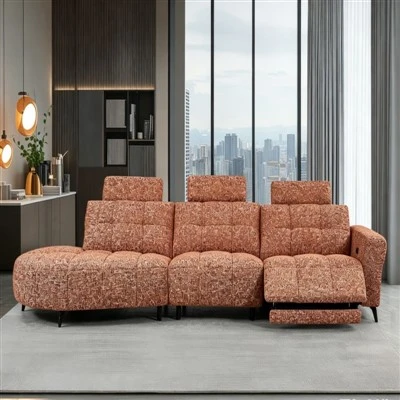
If you’re into big, cozy sofas like sectionals or deep seating models, the average jumps up. A leather sectional, which is super popular for big families or movie nights, often has a depth of 95-110cm (37 to 43 inches). I’ve heard customers say these feel like “living on them,” and that’s exactly what they’re going for. But here’s the catch: if you’re short, a 110cm depth might leave you hanging—your feet might dangle, or you might have to scoot forward every time you want to stand up. If you’re tall, you might actually prefer that deeper depth; I’m 6’2”, and I always test a sofa’s depth by leaning back—if my knees don’t hit the front edge, that’s a win for me.
We’ve also noticed that regional preferences play a huge role in what’s considered “average.” In Europe, where apartments are often smaller, the average leather sofa depth tends to be on the shallower side—80-85cm. We ship a lot of sofas to the UK, for example, and their typical sofa depth there is around 82cm, because most living rooms are compact. Over here in North America, though, we lean a little deeper—90cm is pretty standard, with some customers going even deeper for their media rooms. It all comes down to how people use their space.
Let’s get into why depth matters more than you think, especially with leather. Leather is a sturdy material, but it’s not like fabric—you can’t just “fluff” a leather cushion to make it fit better. If your sofa is too shallow, the leather will stretch over time in the wrong places, leaving you with gaping seat cushions that don’t support you. If it’s too deep, you might end up sitting too far back, and the backrest won’t give you the lumbar support you need, leading to back pain after long sessions. Our team tests every sofa we supply for ergonomics, and we’ve found that the sweet spot average is exactly that 85-90cm range for standard sofas—it’s balanced for support and comfort.
Wait, what about people with mobility issues or kids? A lot of our customers who have young kids or elderly family members ask if a deeper sofa is a bad idea. Actually, it just depends on how you use it. If you have trouble standing, a sofa that’s too deep can make it harder to push yourself up—you have to lean forward more, which is tough if you have knee or hip pain. For those folks, we recommend sticking closer to the lower end of the average, around 80-85cm. For kids, a slightly deeper sofa is actually good—they can sit cross-legged, play games, and the leather is easy to wipe down without worrying about scuffs (though that’s a whole other topic about leather care!).
I should also mention that “average depth” isn’t a rigid rule. Some of our most popular sofas are right in that 85-90cm range, but we’ve had customers request custom depths, too. For someone with a really large living room and a thing for curling up with a blanket, a 95cm depth is perfect. For someone furnishing a tiny studio, a 78cm depth works great. The key is to measure your space before you buy—leave at least 30cm between the back of the sofa and the wall so you can open doors or walk behind it, and make sure the depth doesn’t block any walkways in your living room.
Let’s talk about what our customers actually choose, because that’s the real average. Last year, we sold over 12,000 leather sofas, and when we looked at the data, the most common depth our clients picked was 88cm. That’s right in the middle of the 80-95cm average I mentioned earlier. People told us they liked that it was deep enough to feel cozy but not so deep that it took over their living room. It’s the kind of sofa that works for movie nights and Sunday coffee with friends, which is exactly what a living room sofa should do.
A few common mistakes we see buyers make: first, only looking at the length of the sofa and ignoring the depth. A 2.5m long sofa might seem like a great deal, but if it’s 100cm deep, it’ll make your living room feel cramped, even if the length is right. Second, not testing the sofa in person (we get it, online shopping is easy, but if you can, sit on it for 5 minutes—if your feet don’t touch the floor and you feel like you’re sinking in, it’s too deep; if you’re teetering on the edge, it’s too shallow). Third, confusing seat depth with overall depth—don’t just go by the spec sheet, ask for the seat depth specifically, because that’s where you sit.
For anyone who’s wondering, leather is actually a great material for getting the right depth. Unlike fabric sofas that might sag over time, high-quality leather holds its shape, so the depth you buy is the depth you’ll have in 5 or 10 years. That’s why our team only sources top-grain leather for our sofas—it’s durable, it ages well, and it maintains that consistent depth so you don’t have to worry about it changing. We’ve had a customer whose 10-year-old leather sofa still has the same depth as the day they bought it, and that’s the kind of quality we stand behind.
Now, if you’re in the market for a leather living room sofa, you might be thinking, “Okay, so average depth is 80-95cm—but what’s right for my space?” That’s where we come in. We don’t just sell sofas; we help people figure out what fits their living room, their lifestyle, and their budget. Whether you’re furnishing a 1-bed apartment in the city or a big suburban home, we can point you toward sofas that hit that average depth range, or even custom options if you need something specific. A lot of our clients tell us they were overwhelmed by all the choices, but once we talk through depth, space, and how they use their living room, it’s way easier.
I know shopping for a sofa can feel tedious—there are so many measurements, materials, styles to pick from. But depth is one of the most important numbers to get right. Skip the sofas that are too shallow (they’ll feel cheap after a year) and the ones that are way too deep (they’ll waste space and be uncomfortable). Stick to that average 80-95cm range, adjust for your space, and you’ll end up with a sofa that’s perfect for you.
If you’re ready to browse our leather living room sofas or just have questions about depth, size, or anything else, we’re here to help. Don’t hesitate to reach out—we’ve got a team of folks who know every detail of our sofas, and we’ll walk you through everything so you feel confident in your purchase.
Sectional Sofa References
- Furniture Industry Research Association. (2022). Ergonomic Guidelines for Residential Sofas.
- National Home Furnishings Association. (2023). Consumer Trends in Living Room Furniture.
- International Organization for Standardization. (2021). Standard for Sofa Dimensions and Comfort.
- Leather Naturally. (2022). Durability of Leather Furniture vs. Other Materials.
Huizhou Ramson Technology Co., Ltd.
Huizhou Ramson Technology Co., Ltd. is one of the most professional leather living room sofa manufacturers and suppliers in China, also supports customized service with low price. Please feel free to wholesale bulk classy leather living room sofa from our factory. Contact us for pricelist.
Address: Building 3-4, Changlonggang Industrial Park, Tiantou Village, Shatian Town, Huiyang District, Huizhou City, Guangdong Province
E-mail: jscsofa@jsc-furniture.com
WebSite: https://www.jsc-sofa.com/
